
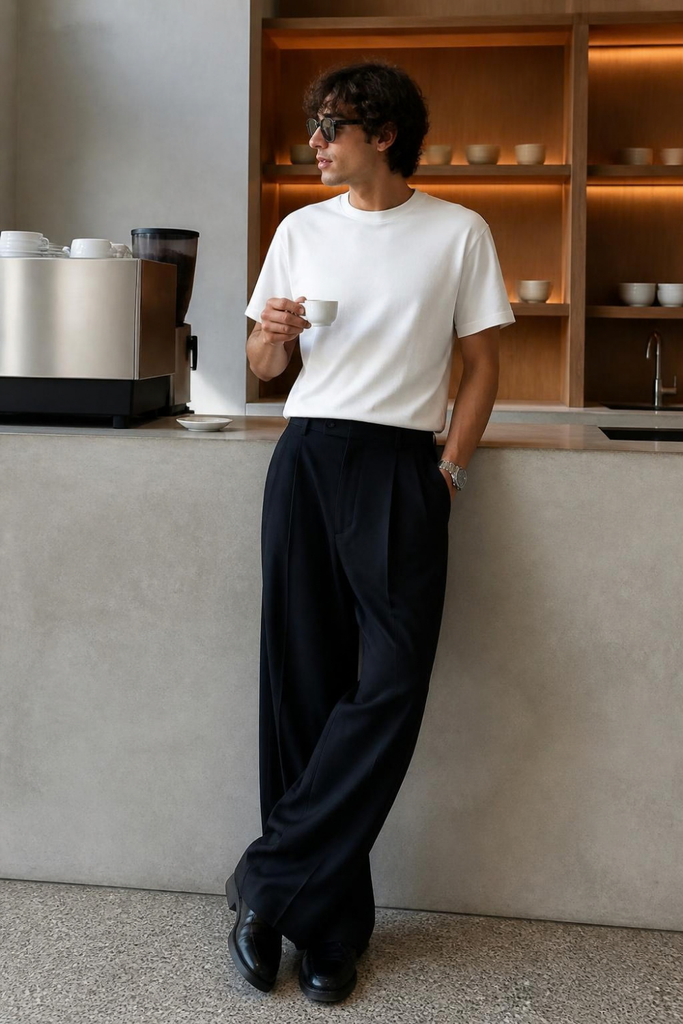
You own the plain tees and the good jeans. Maybe you even have the perfect black hoodie. Still, every outfit somehow looks like you got dressed in the dark.
I get it. I spent years thinking the fix was buying more stuff. It’s not. Learning how to style basic clothes has almost nothing to do with what’s in your closet and almost everything to do with how you put it together. Fit, fabric, color, proportion, and a few small choices are what separate an outfit that looks intentional from one that looks like a default setting.
If your closet feels like a pile of pieces that don’t talk to each other, start with Why Your Wardrobe Feels Chaotic. This post picks up where that one leaves off. Below are the 8 things that actually make basics look good, plus 5 outfit formulas you can copy this week.
What Counts as a “Basic” Anyway
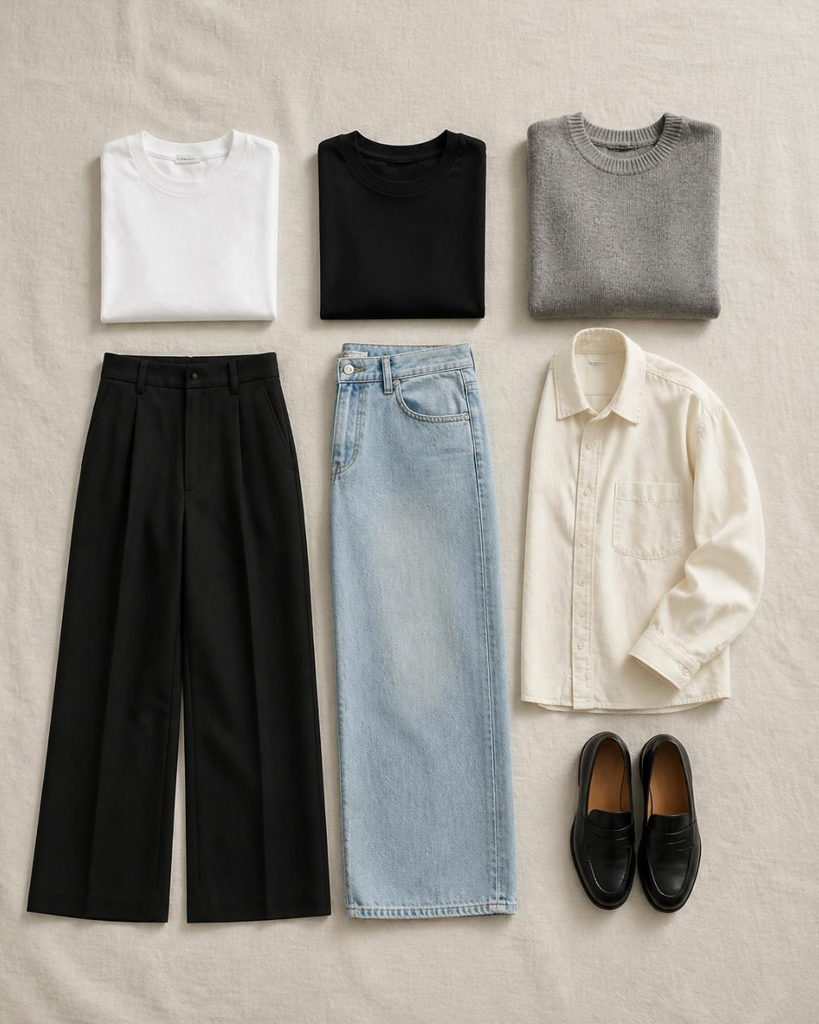
A basic is any piece that’s simple on purpose. No loud graphics, no logos taking up your whole chest, no trend detail that dates it in six months. Think plain tees, crewnecks, hoodies, straight or relaxed jeans, chinos or trousers, an overshirt, a clean pair of sneakers.
The point of a basic is that it works with almost everything else you own. That’s also the problem. Because basics are so easy to throw on, most people stop thinking once they’re dressed. The pieces are fine. The styling is what’s missing.
If you’re still figuring out which pieces belong in that foundation, I broke it down in Wardrobe Essentials Minimalist Dressers Actually Need. This post assumes you already have most of them and want them to look better.
1. Fit First: The Fastest Way to Make Basics Look Expensive
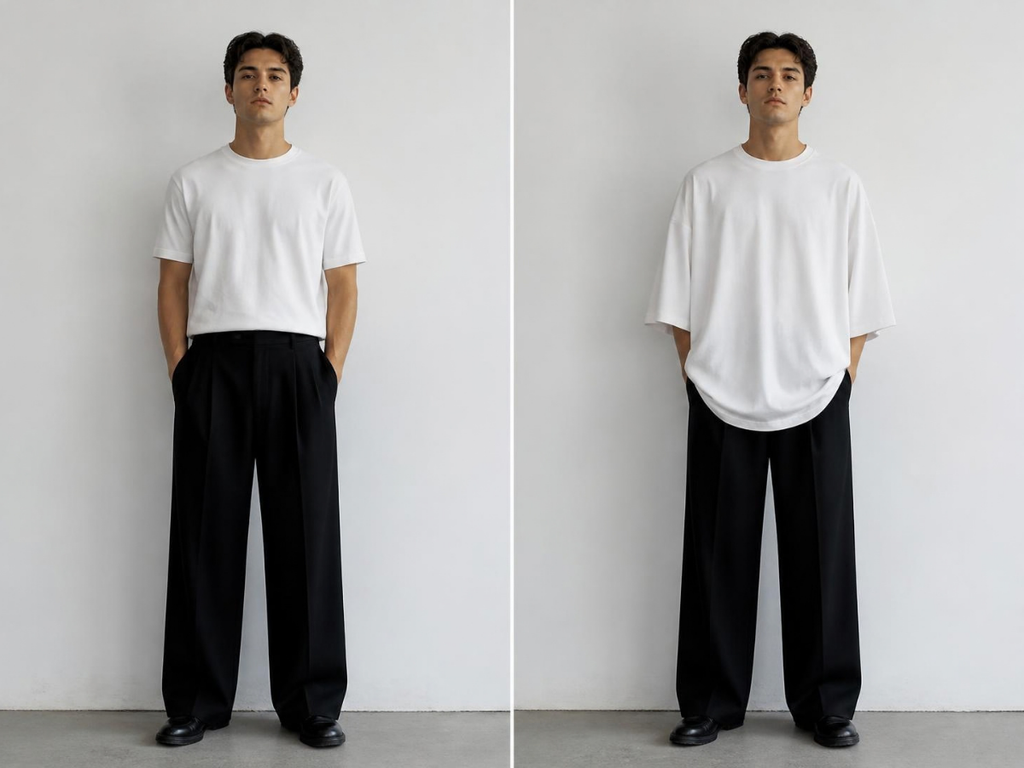
If you only take one thing from this post, take this: fit does more work than any other choice you make. A $15 tee that fits right will look better than a $90 tee that doesn’t. Plain clothes have nowhere to hide, so every fit problem shows.
Shoulders, Sleeves, and Hems
Start with three checkpoints on any top.
- Shoulders. On a regular-fit tee, the shoulder seam should sit right at the edge of your shoulder. Too far in and it pulls. Too far down and it looks borrowed.
- Sleeves. Tee sleeves look best hitting around mid-bicep. Long, floppy sleeves make your arms look shorter and the whole shirt look tired.
- Hem. An untucked tee should land right around your waistband. Much past that and it starts eating your legs, especially with wide-leg pants.
For pants, the big one is the break, or how much fabric stacks at your shoe. A little stack or a clean hem both work. A pile of fabric pooling over your sneakers does not.
Also, don’t sleep on alterations. When I first started thrifting, a lot of the tees I found were too long and too baggy. My grandma would hem them for me, and shirts I almost passed on turned into some of my favorite pieces. A quick hem from a tailor, or from a family member who sews, is usually cheap, and it’s the closest thing to a cheat code in getting dressed. If a piece is almost right, it’s worth fixing instead of replacing.
When Oversized Works and When It Just Looks Big
Oversized is a style, not an excuse. The difference is intention. An oversized tee that’s designed to drop at the shoulder, with a boxy body and a shorter length, looks deliberate. A regular tee two sizes too big just looks like the wrong size.
The rule I follow: if one piece is loose, keep something else in the outfit structured. A boxy tee with straight trousers works. A boxy tee with baggy sweats and an oversized jacket turns into a blob.
2. Fabric and Quality You Can Actually See
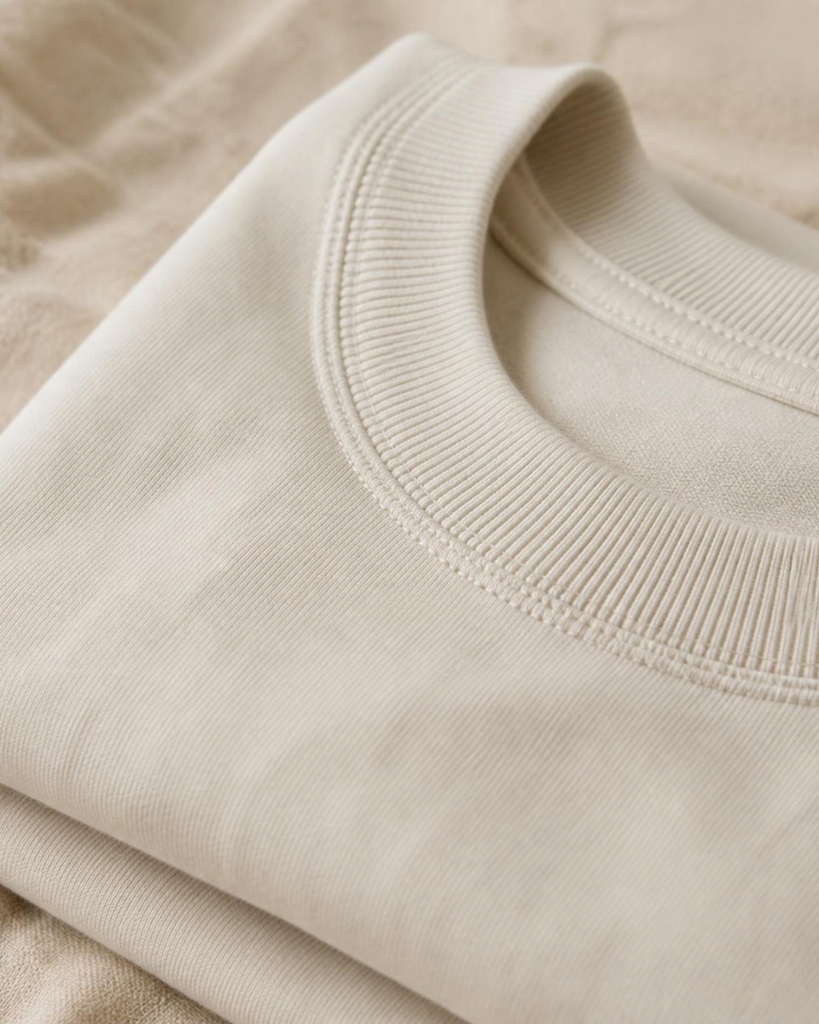
Before I ever designed anything, I spent a lot of time going through thrift racks. That’s where I learned what good fabric feels like, and I wrote about it in What Thrifting Taught Me About Building a Clothing Brand. The short version is that quality is visible, even from across a room.
Here’s what to look for:
- Weight. Thin tees cling, show everything underneath, and twist after a few washes. Heavier cotton drapes better and holds its shape. Fabric weight is measured in GSM, or grams per square meter, and Printful’s T-shirt weight guide explains it well. Most tees land somewhere between about 130 and 220 GSM, and the higher end is where basics start to look substantial.
- Collars that hold their shape. A collar that ripples or stretches out is the fastest tell that a tee has seen better days. Look for a ribbed collar that lies flat.
- Clean seams. Straight stitching, no loose threads, and side seams that don’t twist toward the front after washing.
You don’t need everything to be premium. But the pieces you wear the most, like your go-to tee and your everyday pants, are where quality pays off.
Shop basics built to last. Every bykobeintharath piece starts with fabric that holds its shape.
3. Build a Palette So Everything Works Together
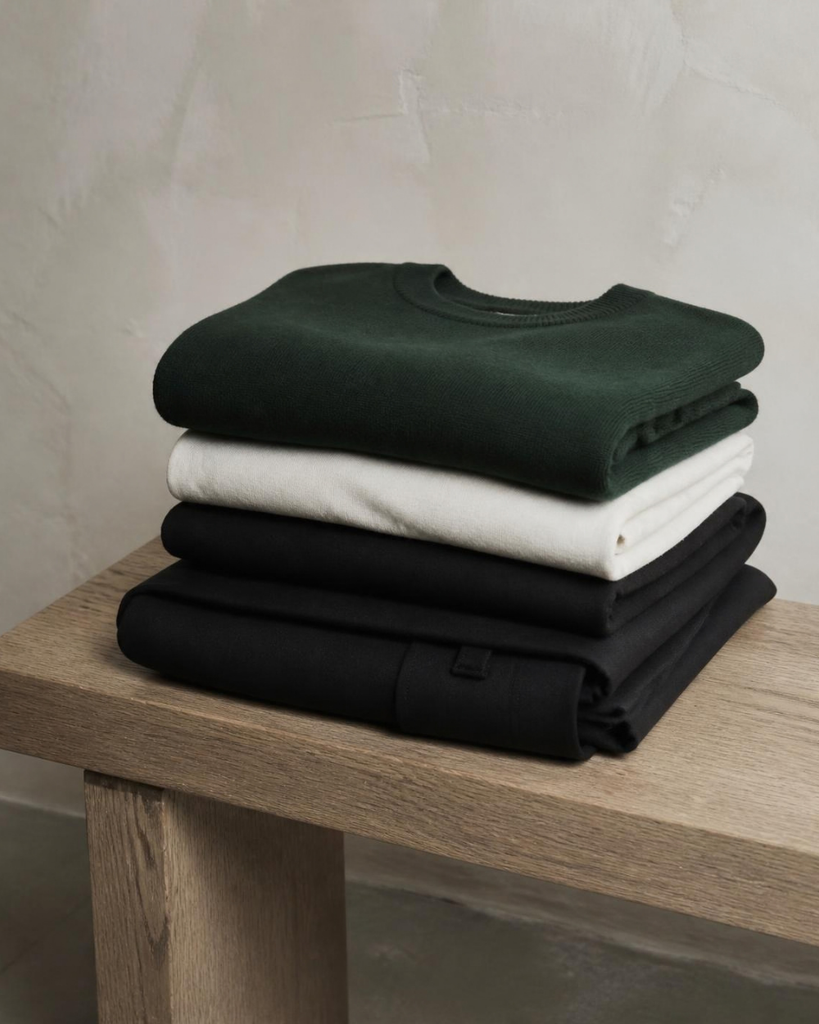
Basics look random when the colors are random. Basics look styled when the colors relate to each other.
You don’t need a strict rule. You need a simple framework: two neutrals and one anchor color. Neutrals are your workhorses, like black, white, off-white, gray, navy, or tan. The anchor is the color that gives your wardrobe a personality. At bykobeintharath, that’s forest green with off-white and black. Every piece connects to every other piece, so you can grab anything in the dark and it works.
If you’re not sure what pairs well, play around with the Adobe Color wheel. Pick one color you love and look at the muted versions around it. That usually gets you to a palette you can live in.
A few things that make a palette work:
- Tonal outfits, like all black or cream on cream, almost always look intentional.
- Pair one lighter piece with one darker piece so the outfit has contrast.
- Let the anchor color show up once per outfit instead of everywhere.
Build your foundation first. A palette is the first step in a wardrobe that works. My capsule wardrobe guide walks through the full process.
4. Play With Proportions and Silhouette
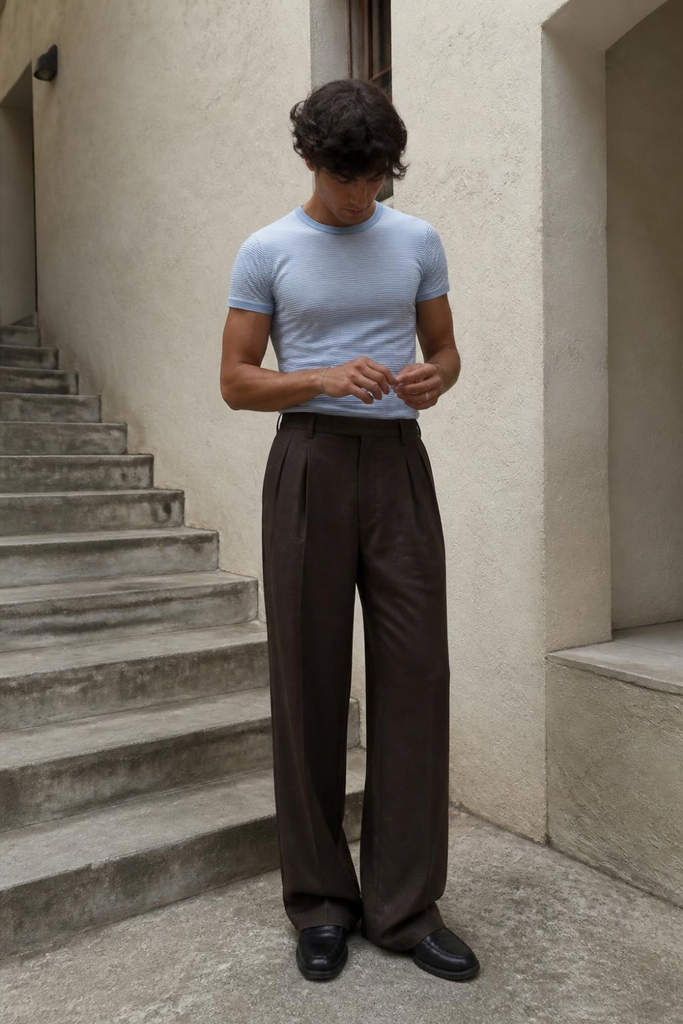
Proportion is how the top half and bottom half of an outfit relate. It’s the thing most people never think about, and it’s why two outfits made of the same pieces can look completely different.
The simplest way to think about it is to balance volume. If one half is loose, the other half should be more fitted or more structured.
- Fitted top, wide pants. A slim or regular tee with wide-leg trousers or relaxed jeans looks clean and current.
- Boxy top, straight pants. A cropped, boxy tee or crewneck with straight-leg pants keeps things sharp without feeling tight.
- The waistband hem. A top that ends right at the waistband shows where your waist is and keeps wide pants from swallowing you. If a tee runs long, a quick hem or a front tuck gets you the same effect.
Length matters too. A top that ends at your waistband with pants that fall long and straight over your shoes shows your shape. A long top over long, baggy pants hides it.
5. Layering: How Basics Start to Look Styled
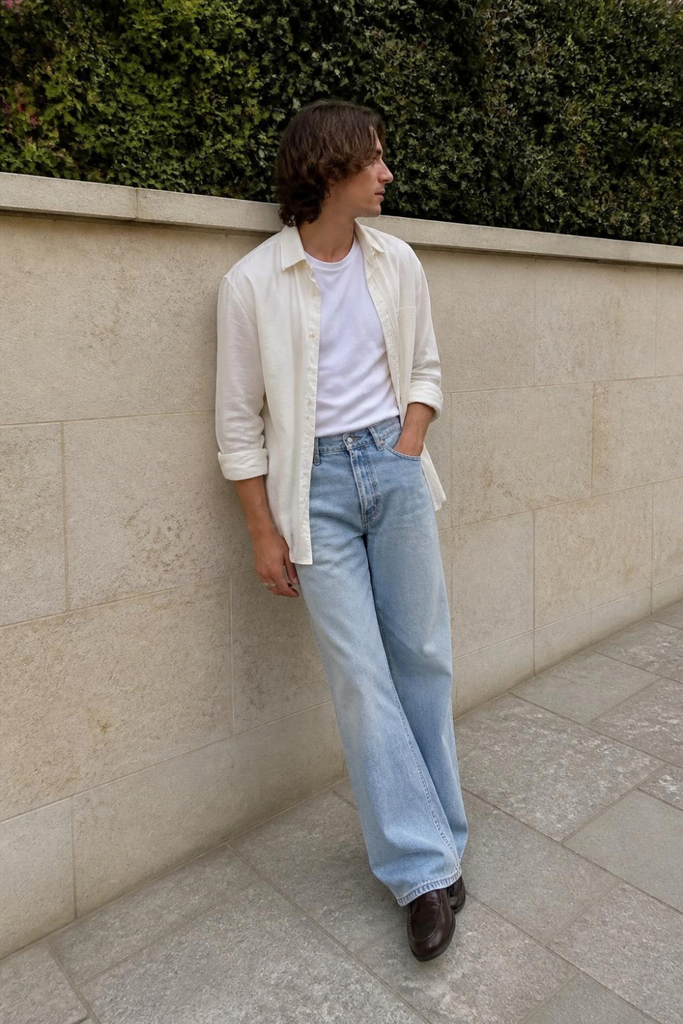
Here’s a simple idea that changes a lot: two pieces is clothes, three pieces is an outfit. A tee and jeans is getting dressed. A tee, jeans, and an overshirt is a look.
The Third Piece Rule
The third piece is anything you add on top of your base. Some easy options:
- An open overshirt or flannel
- A light jacket, like a chore coat or a bomber
- A cardigan or a zip-up knit
- A crewneck thrown over the shoulders
Layering also gives you depth. When different lengths and colors stack on top of each other, the outfit has more going on without anything being loud. A white tee peeking out under a gray crewneck under an open black jacket is still a basic outfit. It just looks like you thought about it.
Colder months make this even easier, since layering is basically required. I wrote a full seasonal guide in How to Build a Fall/Winter Capsule With Elevated Basics.
6. Mix Textures So Neutrals Don’t Fall Flat
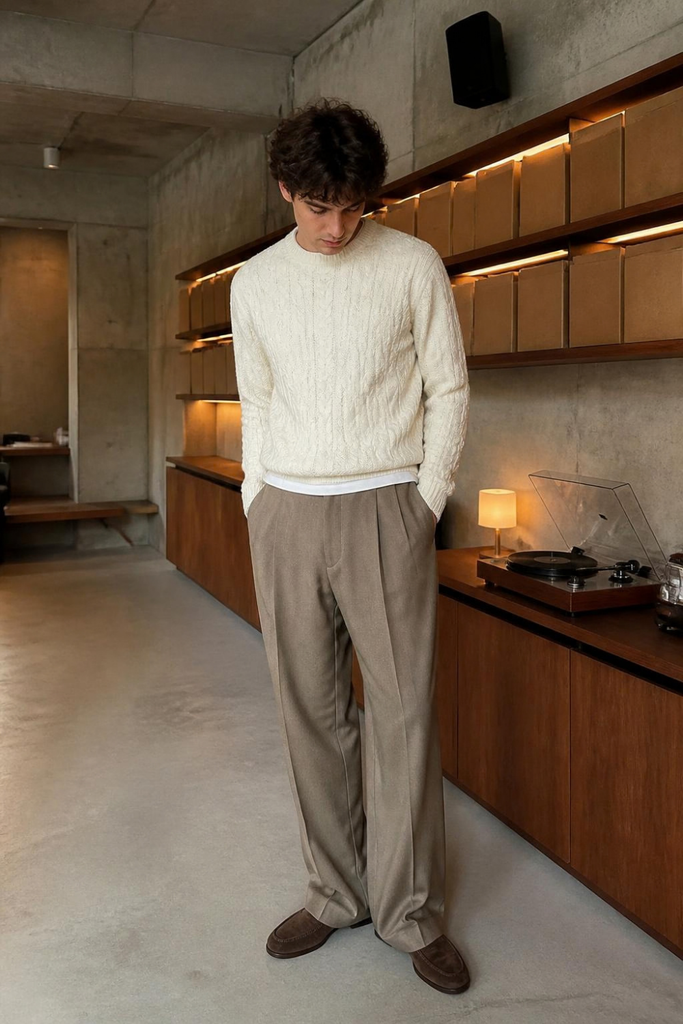
When an outfit is all one color, texture is what keeps it interesting. Without it, an all-black fit can look like a uniform. With it, the same colors look rich.
Try pairing pieces that feel different from each other:
- Smooth cotton with a chunky knit
- Denim with suede or leather
- A crisp overshirt with a soft fleece
- Ribbed fabrics against flat ones
You don’t need to overthink it. If every piece in your outfit is the same fabric, swap one of them for something with a different feel.
7. Shoes Change the Whole Outfit
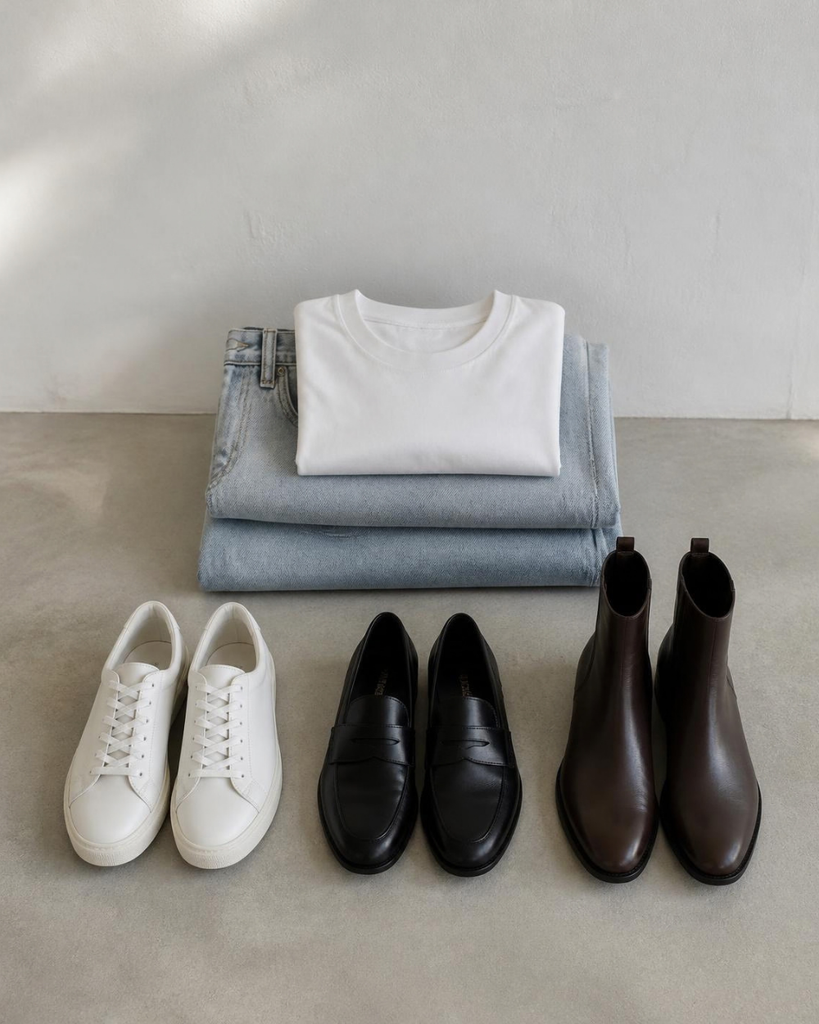
Put the exact same jeans and tee on with three different pairs of shoes and you get three different outfits.
- Clean white sneakers keep it casual and fresh.
- Loafers make it feel a little more grown-up without trying too hard.
- Boots add weight and work well with heavier fabrics in the colder months.
Whatever you wear, keep them clean. Beat-up shoes can drag down an outfit that’s otherwise dialed in. And match the shoe to the vibe of the pants: chunky shoes with wide pants, slimmer shoes with slimmer pants.
Socks count too. With trousers and loafers, a sock that matches your pants or shoes keeps the line clean. With sneakers and shorter pants, a plain white or black crew sock is the easy move. Novelty socks can work, but with a basic outfit they tend to become the only thing anyone notices.
8. Accessories: The Finishing Layer
Accessories are where basics go from fine to finished. A simple watch, a chain, a cap, a belt, a good bag. One or two of these is plenty. You’re adding a detail, not a distraction.
The key is that accessories should feel like part of your palette. Silver or gold, not both. A cap that matches your shoes. A belt that ties your shoes and bag together.
It also helps to pick one focal point. If you’re wearing a statement watch, keep the rest quiet. If the cap is doing the work, skip the chain. When every accessory is competing for attention, the outfit stops looking minimal and starts looking cluttered, which is the opposite of what basics are good at.
I went deep on this in How the Right Accessories Can Elevate Even the Most Basic Outfit, so check that out if you want specific pieces and pairings.
5 Outfit Formulas Using Only Basic Clothes
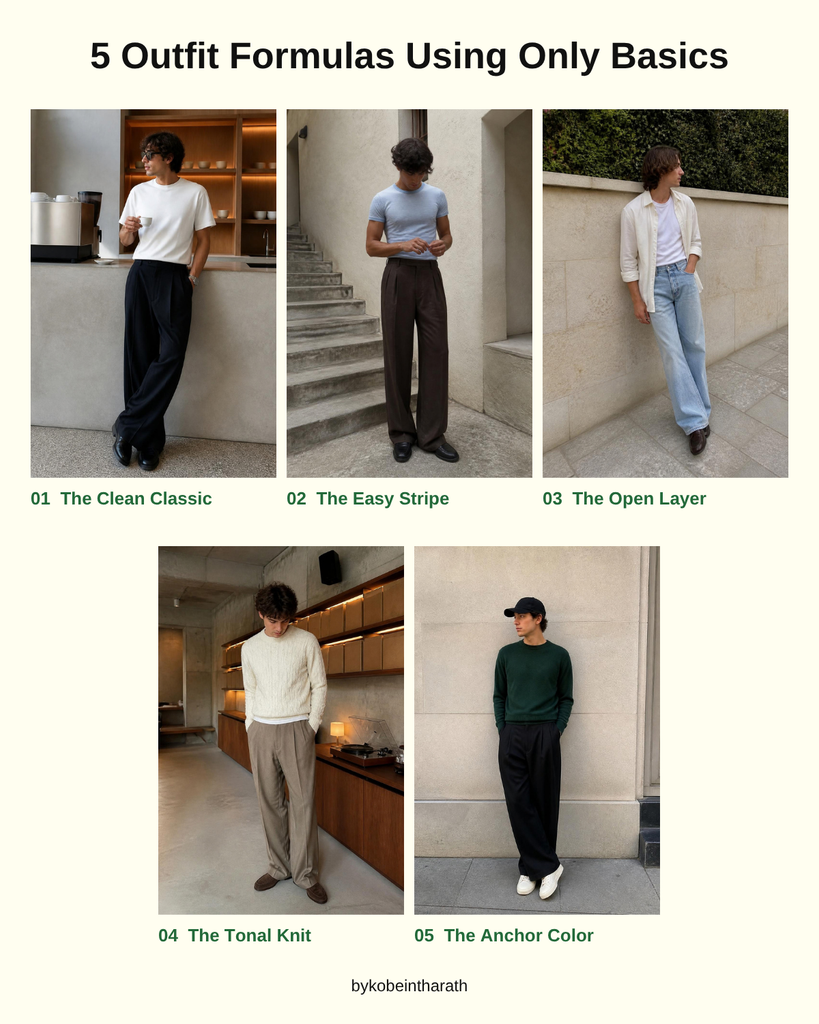
Here’s how all of this comes together. Each formula uses pieces you probably already own.
- The clean classic. White heavyweight boxy tee that hits right at the waistband, black wide-leg pleated trousers, black loafers, and a simple watch. Works for class, work, or dinner.
- The easy stripe. Fitted striped tee, dark brown wide-leg pleated trousers, and black loafers. One subtle pattern does the work, so everything else stays plain.
- The open layer. White tee, an off-white overshirt left open with the sleeves rolled, light-wash wide-leg jeans, and brown loafers. Relaxed, but still put together.
- The tonal knit. Cream cable-knit sweater with a white tee hem peeking out, taupe wool wide-leg trousers, and brown suede loafers. Same color family, different textures.
- The anchor color. Forest green crewneck that ends at the waistband, black wide-leg trousers, off-white sneakers, and a black cap. One color moment, everything else neutral.
Start with whichever formula is closest to what you already wear, then swap one piece at a time.
Save these formulas for later. Pin them for your next getting-dressed slump, and follow bykobeintharath for more outfit ideas built on basics.
Common Mistakes That Make Basics Look Basic
Even with the right pieces, a few habits can undo everything above.
- Ignoring fit because “it’s just a tee.” Plain clothes show fit problems more than anything else.
- Wearing stretched-out or faded pieces. Once a collar ripples or black turns gray, it’s time to retire it to sleepwear.
- Too many colors with no plan. Random colors make basics look accidental.
- Same volume top and bottom. All baggy or all tight usually looks off. Balance it.
- Skipping the third piece. Two pieces plus nothing else is why most basic outfits feel unfinished.
- Buying more instead of styling what you have. A new tee won’t fix an outfit if the proportions and colors are still off.
- Over-accessorizing. Trying to rescue a plain outfit with five accessories just makes it busy.
FAQ: How to Style Basic Clothes
What are basic clothes?
Basic clothes are simple, versatile pieces without loud graphics or trend details, like plain tees, crewnecks, hoodies, jeans, trousers, and overshirts. They’re the foundation most outfits are built on.
How do I make a plain t-shirt look good?
Start with fit: shoulder seams at the edge of your shoulder, sleeves around mid-bicep, and a hem that lands right around your waistband. Then pair it with wide-leg trousers, add a third layer like an overshirt, and finish with clean shoes.
How many basics do I actually need?
Fewer than you think. A few tees, a couple of pants, one or two layers, and one versatile pair of shoes is enough to start. My capsule wardrobe guide breaks down a simple starting framework.
What colors work best for basic clothes?
Neutrals like black, white, off-white, gray, navy, and tan are the easiest to mix. Pick two neutrals plus one anchor color so everything in your closet works together.
Are expensive basics worth it?
Not always. Fit matters more than price. But for the pieces you wear most, heavier fabric, collars that hold their shape, and clean seams are worth paying for because they last longer and look better.
Conclusion: Build Less, Style Better
Knowing how to style basic clothes is really about paying attention. Get the fit right. Choose fabric that holds up. Stick to a palette. Balance your proportions, add a third piece, mix textures, pick the right shoes, and finish with one or two accessories.
None of that requires buying a whole new wardrobe. It also matters more than it might seem. The EPA estimates that 11.3 million tons of textiles ended up in U.S. landfills in 2018. Wearing fewer, better pieces more often, and styling them well, is a better approach for your closet and for everything else.
That’s the whole idea behind bykobeintharath. Quality over noise. Pieces that connect, built to last, and simple enough to style a hundred different ways.
Ready to build your foundation? Start with the pieces you’ll actually wear every week.
Questions about fit or sizing? I’ll help you find the right piece.